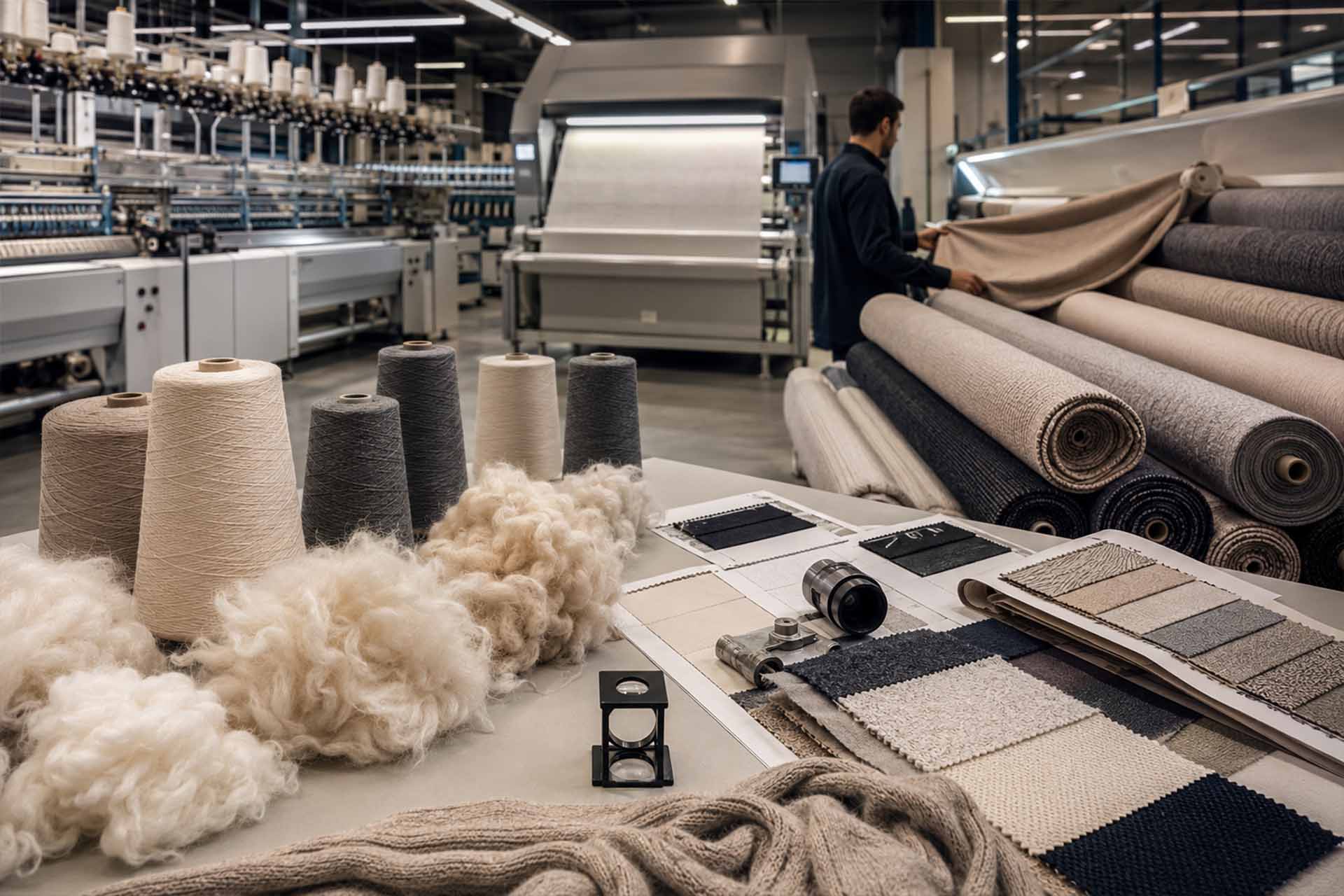
A bale of fibre does not become yarn in a single step. It passes through a chain of machines, each preparing the material for the next. Some stages, such as spinning, get most of the attention. Others work more quietly in the background. The drawing process belongs in the second group, yet its influence on the finished yarn is hard to overstate. To see why, it helps to follow the whole journey.
The Journey From Bale to Yarn
Opening and Cleaning
Compressed bales are first opened into small tufts, and impurities such as dust, seed fragments, and short fibre debris are removed. Where different fibres or lots are used, they are blended at this stage as well.
Carding
The card separates the tufts into individual fibres and assembles them into a continuous sliver. Carding does a great deal of work, but the sliver it delivers is still irregular, with uneven weight along its length and fibres in a largely disordered arrangement.
Combing, When Required
For finer, smoother yarns, an additional combing step removes short fibres and improves parallelization. Not every yarn goes through this process, but those that do are typically intended for higher-quality products.
Where Drawing Fits
After carding, and after combing where it is used, the sliver arrives at the drawing frame. Here several slivers are combined and drafted together, which evens out weight variations and aligns the fibres more closely with the sliver axis. Many mills carry out more than one passage, with the second passage refining what the first achieved.
This is also a practical point for blending. Slivers of different fibres can be fed together in chosen proportions, giving mills a controlled way to produce blended yarns. Because the machine mixes while it levels, blend ratios and sliver evenness can be managed in one operation.
How Drawing Shapes Later Spinning Operations
What the spinning machines can achieve depends largely on what they are given. In ring spinning, the sliver from the drawing frame is usually thinned further on a roving frame before being spun. In rotor and some other spinning systems, drawn sliver is fed to the spinning machine directly, so its quality has an even more immediate effect.
In both cases, the consequences of an uneven sliver are predictable. Variations in weight lead to variations in yarn count. Poorly aligned fibres reduce strength and increase the chance of end breaks. Spinning machines that stop frequently produce less, and the yarn they do produce may be harder to weave or knit.
Why Faults Are Hard to Fix Later
A useful rule of thumb in spinning is that quality is built in early. Once fibres have been twisted into yarn, their arrangement is fixed. Later stages can mask a few problems, but they cannot reverse them. Investing attention in the drawing stage is therefore one of the more cost-effective ways to protect overall yarn quality.
Common Problems Traced Back to Drawing
When yarn quality slips, the drawing stage is often worth checking first. Typical symptoms and possible links include:
• Uneven yarn count, which can follow from incorrect sliver weight or unstable draft.
• Periodic thick and thin places, which can result from damaged or eccentric rollers.
• Frequent end breaks, which may be linked to poor fibre alignment or sliver irregularity.
• Cloudy or streaky fabric, which can originate in uneven sliver.
Tracing a fault to its source saves time and prevents repeated adjustments at the wrong machine.
Testing and Trial Work Around the Drawing Stage
Because the drawing stage has such a strong influence, many textile laboratories examine it closely. Technical teams may want to see how a new fibre lot behaves, compare alternative blends, or prepare slivers for evenness measurements. A small laboratory drawing frame machine is one of the tools that can support this work, allowing material to be drafted on a modest scale before decisions are made about full production. It sits alongside other textile testing equipment that measures fibre, sliver, and yarn properties.
What Good Drawing Looks Like in Practice
• Sliver weight stays within the targeted range from can to can.
• Evenness measurements show low variation along the sliver.
• Roving and spinning machines run with few interruptions.
• Yarn count and strength stay consistent across production lots.
• Roller coverings and settings are checked on a regular schedule.
These indicators are not exotic. They come from routine measurement and sound maintenance, which is exactly why the drawing stage rewards disciplined mills.
Bringing It Together
Looked at as part of the full workflow, the drawing process is a connecting link. It takes the output of carding and combing, improves it, and hands it on in a form that spinning machines can use well. Mills that understand this relationship are better placed to troubleshoot yarn problems at their source rather than treating symptoms further down the line.
For anyone studying textile production, or responsible for it, the lesson is straightforward. Good yarn is made step by step, and the drawing stage is where much of the uniformity is earned.